
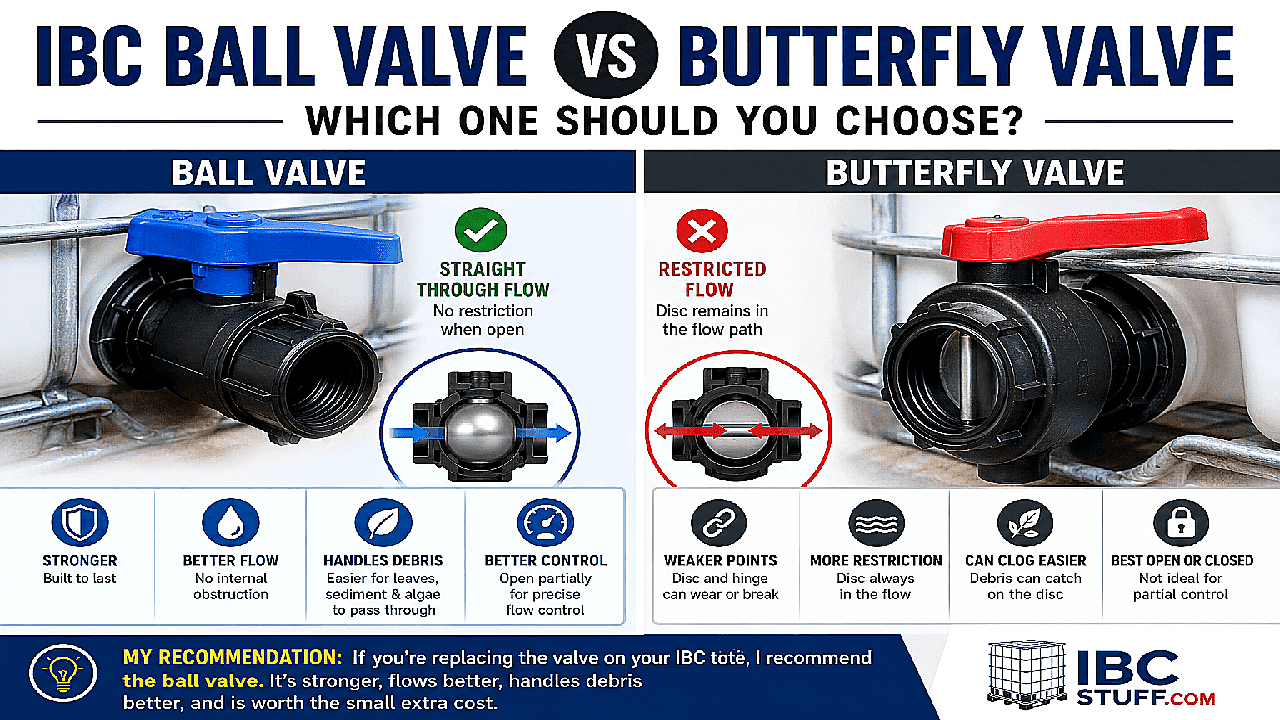
If you’re replacing the valve on your IBC tote, you’ll usually have two choices: a ball valve or a butterfly valve. In this IBC Ball Valve vs Butterfly Valve comparison, I’ll explain why I recommend spending a few extra dollars on a ball valve.
People often ask me which one I would buy.
My answer is simple.
I’d spend the extra couple of dollars and choose the ball valve every time.
Here’s why.
How Each Valve Works
A butterfly valve uses a thin plastic disc mounted on a metal pin. When you turn the handle, the plastic disc rotates to open or close the valve.
A ball valve works differently. Inside is a solid ball with a hole drilled through its center. Turn the handle one direction and the hole lines up with the water flow. Turn it 90 degrees and the flow stops.
That difference may sound minor, but it has a big impact on strength and performance.
Ball Valves Are Stronger
The ball valve is simply a more durable design.
Over the years, I’ve seen plenty of broken butterfly valves. The plastic disc and hinge are the weak points. They work well until they eventually wear out or break.
A quality ball valve has fewer vulnerable parts and is built to handle years of regular use.
Better Water Flow
Another advantage is flow.
When a ball valve is fully open, water travels through a straight, unrestricted passage. That’s exactly what you want when draining a 275- or 330-gallon IBC tote using gravity.
A butterfly valve always leaves the plastic disc sitting in the middle of the flow path. Even when fully open, it creates some restriction.
Will you notice a dramatic difference?
Probably not.
But if you’re replacing the valve anyway, why choose a design that restricts flow when you can install one that doesn’t?
Handles Dirty Water Better
Rainwater harvesting and irrigation systems often contain leaves, algae, sand, or small bits of debris.
A ball valve provides a clear path that allows debris to pass more easily.
A butterfly valve has more internal obstructions where debris can catch, making it slightly more likely to clog over time.
Better Flow Control
A ball valve also gives you excellent control.
You can open it halfway, one-quarter, or anywhere in between to regulate water flow smoothly.
While butterfly valves can also be partially opened, they generally perform best when fully open or fully closed.
Are Butterfly Valves Bad?
Not at all.
Manufacturers install butterfly valves because they’re inexpensive, lightweight, and perfectly suitable for many applications.
If your goal is simply replacing a broken valve at the lowest possible cost, a butterfly valve will do the job.
Ball Valve vs Butterfly Valve at a Glance
| Feature | Ball Valve | Butterfly Valve |
|---|---|---|
| Strength | ★★★★★ | ★★★☆☆ |
| Water Flow | Excellent | Good |
| Flow Restriction | None when fully open | Disc remains in flow |
| Handles Debris | Better | Fair |
| Flow Control | Excellent | Good |
| Typical Cost | Slightly higher | Lower |
My Recommendation
If you’re asking what I’d install on my own IBC tote, I’d choose the ball valve every time.
It’s stronger.
It provides better water flow.
It’s better at handling dirty water.
It’s less likely to cause problems down the road.
Considering the price difference is usually only a few dollars, I think it’s money well spent.
Sometimes the cheapest option isn’t the least expensive in the long run.
If you’re already replacing the valve, upgrading to a ball valve is one of the best improvements you can make.
Read our related articles on adapters and valves, or watch our YouTube videos for visual guidance
- IBC Adapters That Fit The Different Valve Types (Avoid Buying the Wrong One)
- Replacing the Drain Valve on an IBC Tote (What Most Owners Aren’t Told)
- Plastic vs. Metal IBC Hose Adapters: Which Should You Choose?
- What is an IBC Camlock Coupler?
- Adapter That Connects To 3 Different Valve Outlets
- IBC Product Listing Reviews: Exposing Common Thread Mistakes and Misleading Valve
Leave a Reply