
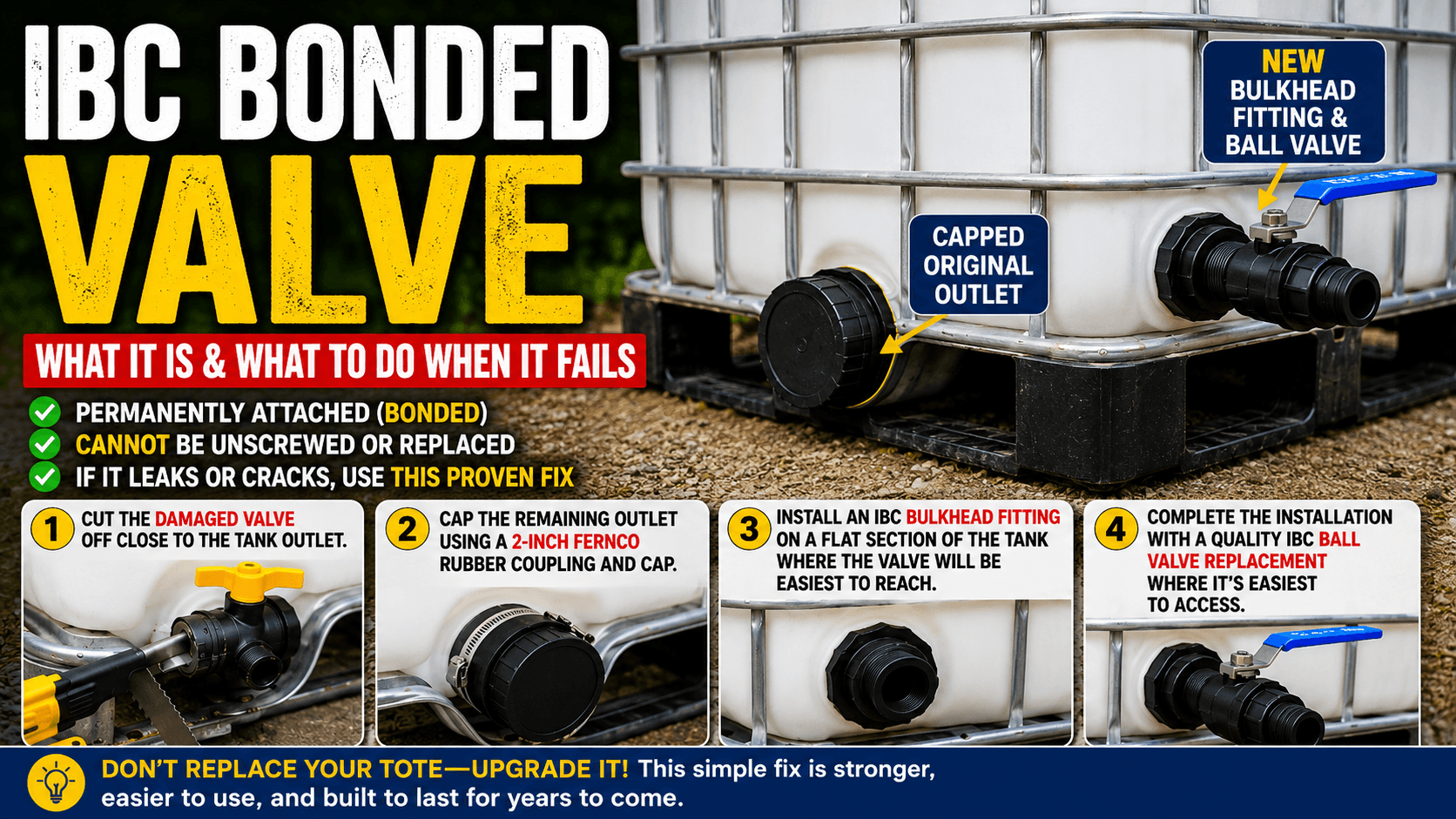
IBC Bonded Valve: Why It Can’t Be Replaced (And What to Do Instead)
Introduction
One of the biggest surprises I’ve discovered since starting the IBC Stuff YouTube channel is how many people own IBC totes with an IBC bonded valve. Many owners contact me because they have an IBC valve glued on and can’t figure out why it won’t unscrew.
When I was only selling replacement valves and fittings, I rarely encountered these totes because their valves can’t simply be removed. After answering countless emails from frustrated owners, I realized there was very little information available about this type of valve.
This guide explains what an IBC bonded valve is, why it causes problems, and what you can do when it eventually fails.
What Is an IBC Bonded Valve?
Unlike a standard threaded valve, an IBC bonded valve is permanently attached to the tank during manufacturing. Instead of screwing onto the outlet, the valve is bonded directly to the plastic tote.
Many people describe this as a glued IBC valve, and that’s a good way to think about it. Whether it is actually glued or bonded during production, the result is the same—it cannot simply be unscrewed and replaced.
If you own a bonded IBC tote valve, you’ll quickly discover that standard replacement valves sold online won’t fit because there are no threads to remove.
Why Bonded Valves Break So Easily
Every permanently attached IBC valve I’ve encountered shares two common characteristics.
First, the plastic body is relatively thin and can crack surprisingly easily.
Second, nearly every one uses an IBC butterfly valve instead of a ball valve. Butterfly valves work well for occasional use, but they generally aren’t as durable as ball valves when opened and closed repeatedly over many years.
This isn’t necessarily poor engineering.
Most IBC totes were never intended to become permanent rainwater tanks or long-term storage containers. They were designed for a single industrial shipment. A manufacturer fills the tote with oil, soap, chemicals, or another liquid, ships it to the customer, and the customer empties it.
After that first use, the tote has already served its intended purpose.
Manufacturers therefore have every incentive to build a container that is safe and reliable for one shipment while keeping production costs as low as possible.
The fact that these totes work so well for rainwater collection is simply an added benefit—not their original purpose.
My Recommendation if Your Valve Still Works
If your IBC bonded valve is still functioning properly, my advice is simple—leave it alone.
Instead, add a brass garden hose ball valve to the outlet.
This provides two important benefits.
- It gives you a convenient garden hose connection.
- It allows you to leave the original IBC butterfly valve open most of the time, reducing wear and helping prevent future leaks.
This inexpensive upgrade can significantly extend the useful life of your tote.
My Recommendation if Your Valve Is Cracked or Leaking
Once a glued IBC valve begins leaking or cracks, repairing it is usually not worth the effort.
Because the valve is permanently attached to the tank, it cannot simply be unscrewed like a standard threaded valve.
Instead, I recommend the following approach.
- Cut the damaged valve off close to the tank outlet.
- Cap the remaining outlet using a 2-inch Fernco rubber coupling and cap.
- Install an IBC bulkhead fitting on a flat section of the tank where the valve will be easiest to reach.
- Complete the installation with a quality IBC ball valve replacement where it’s easiest to access.
Although this sounds drastic, it is often the strongest, simplest, and most permanent repair. A properly installed IBC bulkhead fitting creates a reliable new outlet and allows you to use a standard ball valve that can easily be replaced in the future if necessary.
Why install a new outlet instead of repairing the old one?
Installing a new bulkhead fitting is usually faster and more reliable than trying to rebuild the original bonded outlet. It also lets you position the new valve where it’s easier to reach, easier to connect to plumbing, and much simpler to replace in the future if needed.
Final Thoughts
An IBC bonded valve doesn’t mean your tote has reached the end of its useful life.
In many cases, the tank itself has years of service remaining even after the original valve fails. Whether you have an IBC valve glued on, a bonded IBC tote valve, or another permanently attached IBC valve, understanding its limitations will help you choose the best repair.
For many owners, installing an IBC bulkhead fitting with an IBC ball valve replacement is the most reliable long-term solution. With the right repair, your IBC tote can continue providing years of dependable service.