
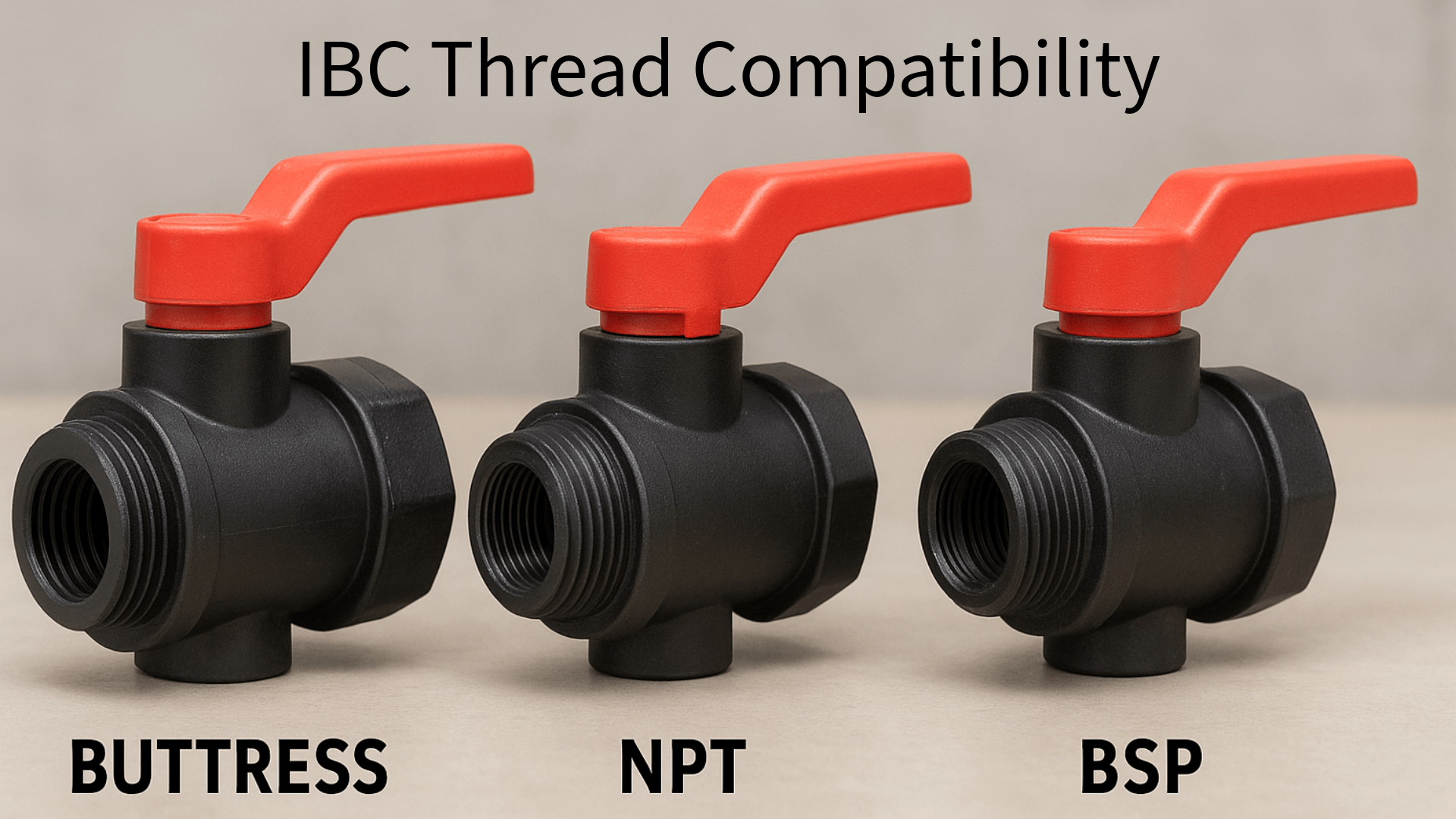
Many people overlook how IBCs were built for global, single-use shipping, and therefore, IBC thread compatibility often confuses new users. IBCs replaced 55-gallon drums and were designed to move liquids between countries. Consequently, IBCs never adopted a universal thread standard. An outlet may use North American, European, or buttress threads. As a result, many people struggle when repurposing IBCs for home or farm projects.
For example, a Texas homeowner may need to attach a garden hose to a British-thread valve. This connection can work with the correct adapter. However, hardware stores rarely carry BSP-to-garden-hose fittings. Therefore, online shopping offers the best chance to find the right part. Unfortunately, many sellers misidentify American and European threads. Because of this, I wrote this guide to help IBC users avoid costly mistakes.
Next, consider the buttress threads found on IBCs. These threads appear as S60x6, S75x6, and S100x8 buttress designs. The first number shows the diameter in millimeters. The second number shows the spacing between thread peaks. These coarse threads twist on easily and rarely leak. For clarity, Americans can view 60, 75, and 100 millimeters as roughly 2, 3, and 4 inches.
Finally, remember that American and European pipe threads differ enough to cause leaks. NPT uses a 60-degree tapered form with flat peaks. Meanwhile, BSP uses a 55-degree form with rounded peaks. Because of these differences, mismatched parts never seal well. Therefore, I recommend avoiding BSP fittings when possible. If you need guidance on IBC thread compatibility, you may email [email protected] for help.